
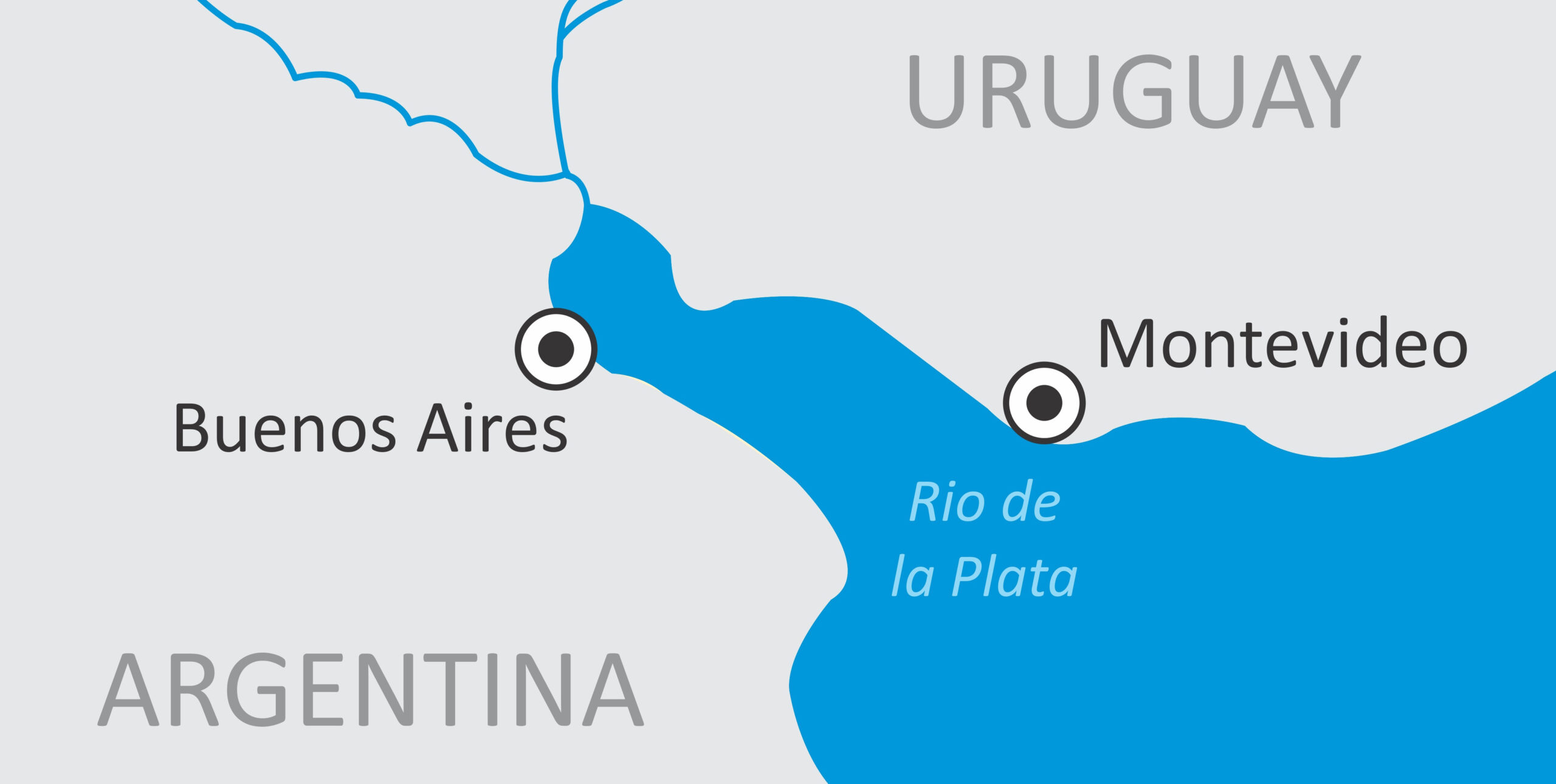
Two neighboring countries. One shared river. Completely different nomad experiences.
Table of Contents
- The Quick Answer
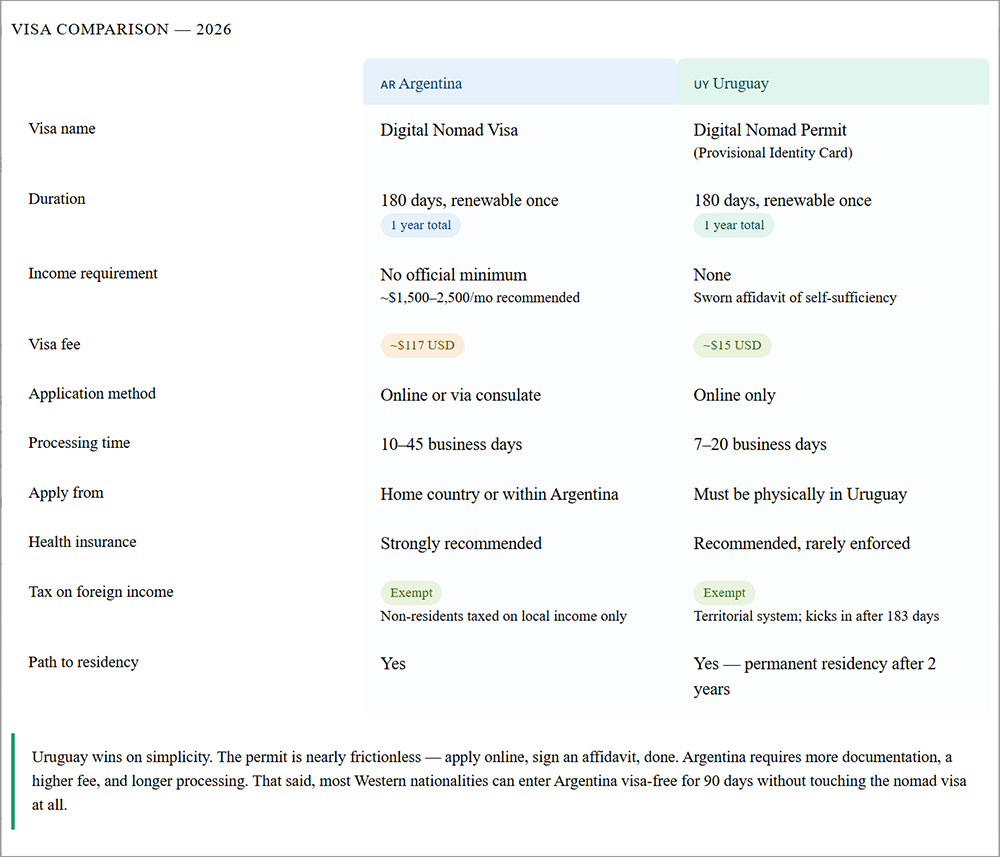
- Visa Comparison
- Cost of Living: The Real Numbers
- The Blue Dollar Explained
- Buenos Aires vs Montevideo: City Head-to-Head
- Safety and Stability
- Internet and Infrastructure
- Healthcare
- Cultural Experience
- Choose Argentina If…
- Choose Uruguay If…
- The Hybrid Approach: Why Many Nomads Do Both
- FAQs
The Quick Answer
Argentina gives you one of the world’s great cities — Buenos Aires — at prices that will make you question why you ever lived anywhere else. Uruguay gives you stability, safety, and simplicity, at a cost that’s noticeably higher but still well below Western Europe or North America.
Most nomads who spend time in the southern cone don’t choose between them. They use Uruguay as a stable base and Argentina as an experience. But if you have to pick one, this guide will tell you which one wins for your specific situation.
Cost of Living: The Real Numbers
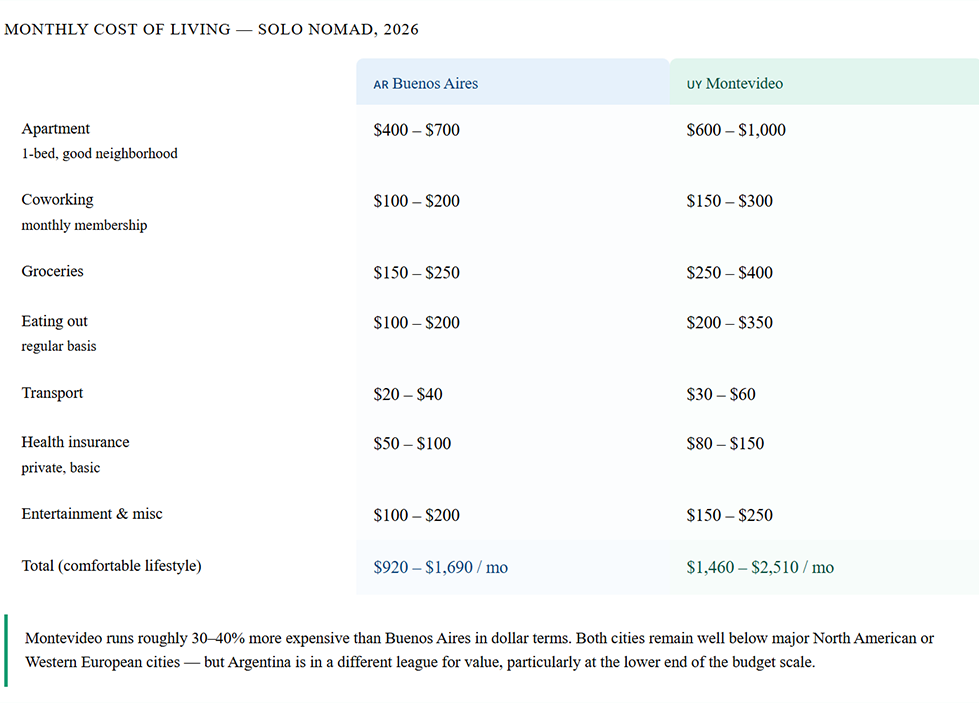
This is where the two countries diverge most sharply — and where the nuance matters.
Why the Gap Exists
Argentina’s affordability is not coincidental. It is a direct consequence of the country’s long-running currency situation and ongoing economic volatility. For nomads earning in dollars, euros, or pounds, Buenos Aires represents one of the best cost-to-quality ratios of any major city in the world right now.
Uruguay’s peso is more stable. The country is more expensive partly because it works. Prices reflect an economy without chronic inflation, without currency distortions, and with real infrastructure investment. You pay a premium for predictability.
The Blue Dollar Explained
If you’re going to Argentina, you need to understand this. It is not optional.
Argentina has historically operated with two exchange rates: the official government rate and the informal “blue dollar” (dólar blue) rate. For years, the gap between the two was enormous — sometimes 80–100% or more — meaning that nomads who exchanged cash informally could double their purchasing power compared to using a foreign card at the official rate.
Under President Milei’s administration, significant currency reforms were introduced beginning in 2024. The official rate was devalued sharply, and the gap between official and blue rates narrowed considerably. As of 2026, the situation is more nuanced than the dramatic arbitrage nomads experienced in 2022–2023.
Here is what you need to know for 2026:
- Credit cards now generally apply something close to the MEP (financial) dollar rate, which is more favorable than the old official rate. Many nomads find that no-fee travel cards work well for everyday spending.
- Cash USD can still be exchanged at informal exchange houses (“cuevas”) or through peer-to-peer services for a somewhat better rate, but the days of doubling your money are largely behind you.
- Prices have adjusted upward in peso terms to account for the rate changes, so the math has changed even if the underlying dynamic hasn’t disappeared entirely.
- The situation can shift. Argentina’s economic policy has changed dramatically before and could again. Always check current rates before you travel and talk to nomads on the ground.
The bottom line: Buenos Aires is still excellent value in 2026. You do not need to become a currency expert to benefit from it. But you should understand the basics, use the right payment tools, and not assume that what you read in a 2022 travel blog reflects current reality.
Uruguay has none of this complexity. You pay with your card, you get a fair rate, and you move on with your life.
Buenos Aires vs Montevideo: City Head-to-Head
These are the two primary bases for nomads in the region. They are separated by a two-hour ferry across the Río de la Plata, and they feel like they exist in entirely different universes.
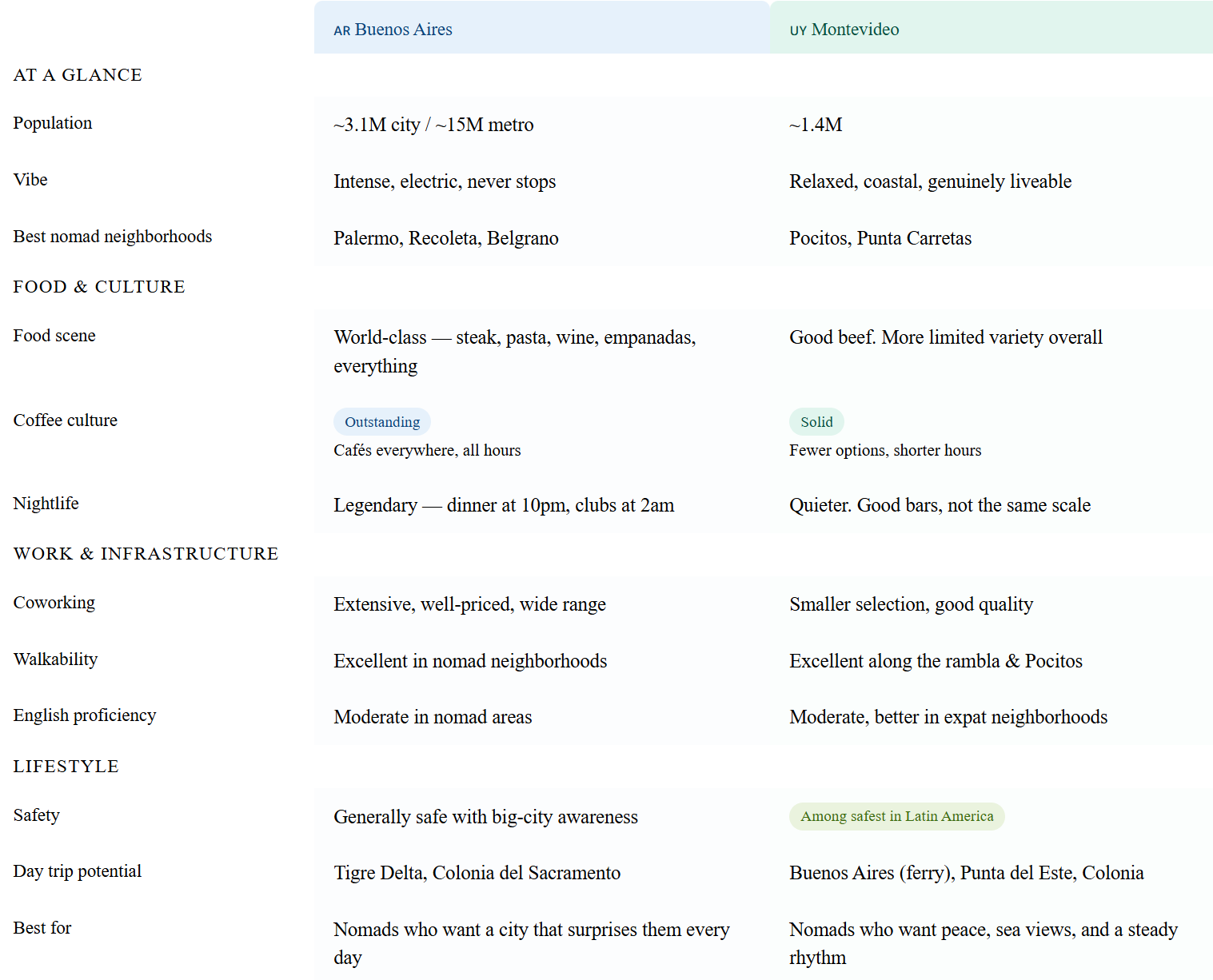
Buenos Aires is a city that works on you slowly. You arrive thinking you’ll stay a month and end up extending three times. The food is genuinely extraordinary, the café culture is as good as anywhere in Europe, and the creative energy — arts, music, design, nightlife — is relentless. It’s one of the few cities in the world where the quality of daily life consistently exceeds expectations.
Montevideo is where nomads go when they want to actually live somewhere rather than be dazzled by it. The rambla — a 22-kilometre coastal promenade — becomes the rhythm of your day. The city is compact, walkable, and genuinely safe. Locals are unusually friendly to foreigners. The pace is slower by design, and most people who stay a while find that’s exactly what they needed.
The doors are open on Nomados Pro!
Plan journeys. Save itineraries. Use Miles, your AI travel assistant, to think through options and decisions. Add services on demand like airport lounges, data plans, and visas when you need them.

Safety and Stability
This is one of the clearest areas of differentiation between the two countries.
| Argentina | Uruguay | |
|---|---|---|
| Overall safety | Moderate — big-city awareness required | High — one of the safest in Latin America |
| Petty crime | Common (phone snatching, pickpocketing) | Exists but less prevalent |
| Violent crime | Rare in nomad neighborhoods | Very low |
| Political stability | Volatile; major policy swings between governments | Consistently stable; strong democratic institutions |
| Economic stability | Chronic instability; inflation history | Stable; peso holds value |
| Safest areas | Palermo, Recoleta, Belgrano | Pocitos, Punta Carretas, Carrasco |
| Areas to be cautious | Downtown/Microcentro at night, San Telmo evenings | Ciudad Vieja at night |
For personal safety day-to-day, Uruguay is the clear winner. Montevideo is genuinely one of the safest major cities in all of Latin America. Most nomads report feeling more relaxed there than anywhere else in the region.
Buenos Aires is safe enough that hundreds of thousands of nomads live there happily — but it requires the same common-sense precautions you’d apply in any large city. Keep your phone in your pocket on the street, be aware of your surroundings, and stick to the well-known nomad neighborhoods and you’ll be fine.
For institutional and economic stability, Uruguay wins decisively. It has not had a currency crisis, a default, or a dramatic government reversal of economic policy in recent memory. Argentina has had all three, multiple times, within living memory of many nomads currently living there. If stability matters more to you than value, Uruguay is the answer.
Internet and Infrastructure
Both countries have solid connectivity for remote work — but with different characters.
| Argentina (Buenos Aires) | Uruguay (Montevideo) | |
|---|---|---|
| Average internet speed | 100–150 Mbps | 150 Mbps+ |
| Fiber availability | Good in major neighborhoods | Excellent nationwide (state-run Antel) |
| Coworking spaces | Extensive, well-priced | Fewer, good quality |
| Café working culture | Outstanding | Good, smaller selection |
| Mobile data | Reliable 4G (Claro, Movistar, Personal) | Reliable 4G/5G (Antel, Claro, Movistar) |
| Power outages | Occasional | Rare |
| Overall reliability | Good, some inconsistency | Very reliable |
Uruguay’s internet infrastructure is notable partly because it is largely state-owned. Antel, the national telecoms company, has built out fiber to a degree unusual for the region. Internet in Montevideo is consistently fast and reliable — it is rarely a point of complaint among nomads.
Buenos Aires has a larger and more varied coworking scene, with options across a wide price range and in every major neighborhood. The café-working culture is exceptional: countless cafés actively welcome laptop workers, with reliable WiFi and outlets, often open until midnight or later.
Healthcare
| Argentina | Uruguay | |
|---|---|---|
| Public healthcare | Available to residents; quality varies | High quality; integrated national system (SNIS) |
| Private healthcare | Affordable and generally good | Good quality; more expensive than Argentina |
| Private insurance cost | ~$50–$100/month | ~$80–$150/month |
| English-speaking doctors | Available in major private clinics | Available, particularly at the British Hospital |
| Emergency care | Available; private recommended | Strong public and private options |
| Pharmacy access | Excellent | Excellent |
| Dental care | Very affordable, good quality | Good, higher cost than Argentina |
Argentina has affordable private healthcare that most nomads find more than adequate for routine care. The public system is strained and best avoided for non-emergencies, but private clinics in Buenos Aires are well-equipped and significantly cheaper than equivalent care in North America or Europe.
Uruguay’s healthcare system is considered one of the best in Latin America. The national integrated system (SNIS) provides a genuine safety net, and private clinics — particularly the British Hospital in Montevideo — are widely trusted by the expat community. You pay more for it than in Argentina, but you get consistent quality.
Cultural Experience
Both countries share a Latin American identity while being quite distinct from the rest of the region — and from each other.
Argentina is an intensely emotional place. The culture is dramatic, passionate, and opinionated. Porteños (Buenos Aires locals) love conversation, debate, politics, and food. The tango is not a tourist performance here — it’s a living tradition. The arts scene is world-class: theater, independent cinema, live music, and street art are everywhere. The food extends well beyond the famous steak: Italian influence means outstanding pasta and pizza; the wine culture, sustained by Mendoza’s vineyards, means excellent Malbec starts at $3–5 a bottle at a wine shop. The city runs late — dinner at 9pm is normal, midnight is not unusual, and the best restaurants are full until 1am.
Uruguay is quieter, gentler, and genuinely progressive. It was one of the first countries in the world to legalize recreational cannabis and same-sex marriage. There’s a social warmth here that is different from Argentina’s intensity — Uruguayans are famously willing to help foreigners, invite you for a coffee, and make you feel genuinely welcome rather than tolerated. Mate culture is strong — even stronger than in Argentina. The food scene in Montevideo is more limited than Buenos Aires but improving, with a growing number of excellent restaurants in Pocitos and the surrounding neighborhoods.
One observation that recurs consistently among nomads who spend time in both: Argentina gives you stories; Uruguay gives you rest.
Choose Argentina If…
- You want maximum value for your dollar. Buenos Aires remains one of the best cost-to-quality ratios of any major city in the world. A very comfortable nomad lifestyle — nice apartment, eating out regularly, great wine — runs well under $1,500/month.
- You want a city that overwhelms you (in the best way). Buenos Aires is one of the great cities on earth. The food, culture, nightlife, and sheer energy of the place is genuinely difficult to replicate anywhere else in Latin America.
- You love café culture. The Buenos Aires café scene is serious — comparable to the best in Europe, open late, welcoming to laptop workers, and deeply embedded in daily life.
- You want to meet other nomads. Buenos Aires has one of the largest and most active nomad communities in Latin America. Facebook groups, Meetup events, and coworking spaces are full of people doing exactly what you’re doing.
- You’re learning Spanish. Buenos Aires is an exceptional place to immerse yourself in Spanish, with a distinctive Rioplatense accent that, once learned, opens the rest of Latin America to you.
- You’re comfortable with some unpredictability. Argentina rewards nomads who can adapt. Currency questions, bureaucratic surprises, and the occasional power outage come with the territory. Most people find the trade-off more than worth it.
Choose Uruguay If…
- Stability is your top priority. Uruguay is the most stable country in Latin America by most measures — economic, political, and social. You can plan your finances without worrying about exchange rate shocks.
- You want simple, frictionless daily life. No currency complications, no rate tracking, no navigating informal exchange systems. You pay with your card, you know what things cost, and you get on with your day.
- Safety matters to you. Montevideo is genuinely one of the safest cities in Latin America. If you want to walk home late at night without thinking twice, Uruguay wins.
- You’re looking for a long-term base, not just a stay. Uruguay’s path to permanent residency (two years with presence of at least six months per year) is real, credible, and used by many nomads who decide to stop moving. Argentina’s equivalent pathways exist but carry more uncertainty.
- You want coastal living. Montevideo’s rambla and the beaches of Punta del Este offer a quality of life that Buenos Aires, landlocked by comparison, simply cannot match. Waking up and running along the coast before work is a different kind of nomad existence.
- You value work-life separation. The slower pace of Montevideo helps many nomads actually disconnect after work. Buenos Aires is so relentlessly alive that the boundary between work time and city time can be difficult to maintain.
- You have a family or dependents. Uruguay’s stability, safety, school system, and overall liveability make it the more sensible choice for nomads traveling with partners or children.
The Hybrid Approach: Why Many Nomads Do Both
The most interesting pattern among experienced nomads in the southern cone is not that they choose Argentina or Uruguay — it’s that they use both.
The two cities are connected by a two-hour high-speed ferry across the Río de la Plata. Buquebus runs multiple crossings daily from Buenos Aires to Colonia del Sacramento and Montevideo. The experience is easy, affordable, and almost absurdly convenient given what you’re getting on each end.
A common pattern looks like this:
- Base in Buenos Aires for 2–3 months. Absorb the city, establish a routine, work from cafés, eat everything, spend very little.
- Do a Uruguay run — legally extend your Argentine stay by crossing to Montevideo or Colonia for a weekend. While there, appreciate how different calm feels.
- Spend a month in Montevideo when you need to decompress, reset, or simply want a change of pace.
- Repeat as needed.
This hybrid approach also works well for visa purposes. The standard tourist entry in Argentina gives you 90 days. A border crossing to Uruguay resets the clock. Many nomads treat Colonia del Sacramento — a charming UNESCO-listed town just an hour by ferry from Buenos Aires — as the easiest and most pleasant border run available anywhere in Latin America.
The southern cone, taken together, is a remarkably complete nomad ecosystem: a world-class metropolis paired with a stable, coastal smaller city, connected by an easy ferry crossing, sharing a language and a love of beef, and offering almost every kind of nomad experience within a very small geographic footprint.
FAQs
Is Argentina or Uruguay cheaper for digital nomads?
Argentina is significantly cheaper — typically 30–40% lower monthly costs than Uruguay. A comfortable solo nomad lifestyle in Buenos Aires runs roughly $900–$1,700/month depending on neighborhood and habits. In Montevideo, expect $1,500–$2,500/month for an equivalent lifestyle. Both countries are well below North American or Western European costs.
Do I need to use the “blue dollar” system in Argentina to get good value?
No longer quite as critical as it was in 2022–2023. Under Milei’s currency reforms, the gap between official and informal exchange rates has narrowed. Many nomads in 2026 find that no-fee travel cards work well and provide near-equivalent value to cash exchanges. Buenos Aires remains excellent value regardless of which method you use — but understanding the system helps you avoid leaving money on the table.
Which country has the easier digital nomad visa?
Uruguay’s is significantly easier. It’s applied for online, requires minimal documentation, costs almost nothing, and is typically approved within one to three weeks. Argentina’s process requires more paperwork, a higher fee (~$117), and can take up to 45 business days through a consulate. That said, many nationalities can enter Argentina visa-free for 90 days and stay comfortably without the nomad visa for shorter stints.
Can I do a border run from Argentina to Uruguay to extend my stay?
Yes, and many nomads do exactly this. A Buquebus ferry from Buenos Aires to Colonia del Sacramento or Montevideo takes one to two hours and effectively resets your 90-day tourist clock. It’s one of the most convenient border run options anywhere in the region. Just be aware that Argentine authorities do occasionally scrutinize frequent border crossers, so using the formal digital nomad visa is the more stable solution for stays beyond a few months.
Is Uruguay safe enough for solo female nomads?
Yes — Uruguay and particularly Montevideo are consistently rated among the best in Latin America for solo female travelers and nomads. The combination of genuine safety, local friendliness, and stable infrastructure makes it a top recommendation in the region. Buenos Aires is also manageable for solo women with standard big-city awareness, particularly in established nomad neighborhoods like Palermo and Recoleta.
Which country is better for long-term residency or tax planning?
Uruguay is generally considered the stronger option for both. Its territorial tax system means foreign income is not taxed during your initial stay, and the path to permanent residency is clear and credible. Uruguay also has a reputation for rule of law and institutional stability that Argentina cannot currently match. Many nomads who are thinking beyond just a long stay — looking at residency, second passport options, or tax structure — are drawn to Uruguay specifically for these reasons. That said, individual circumstances vary significantly, and both situations warrant consultation with a local tax or immigration lawyer before making decisions.
Costs and visa details are accurate as of April 2026. Both countries’ policies and exchange rates are subject to change — always verify current requirements through official government sources before you travel.
Disclosure: Portions of this article were created with the assistance of AI tools and reviewed by the Nomados editorial team for accuracy and clarity.