
Table of Contents
Which Should you Choose?
The Quick Answer
Thailand offers the most established digital nomad infrastructure, better visa options (notably the 5-year Digital Nomad Visa), and a diverse range of environments from Bangkok’s buzzing metropolis to tranquil islands — with monthly costs running $800–$2,400.
Vietnam delivers slightly lower costs ($700–$1,700/month), more authentically raw cultural experiences, and rapidly improving infrastructure, but requires more creative visa navigation: 90-day e-visa resets or agent-assisted business visas. Both are excellent. The right choice depends on your priorities.
Visa Options Compared
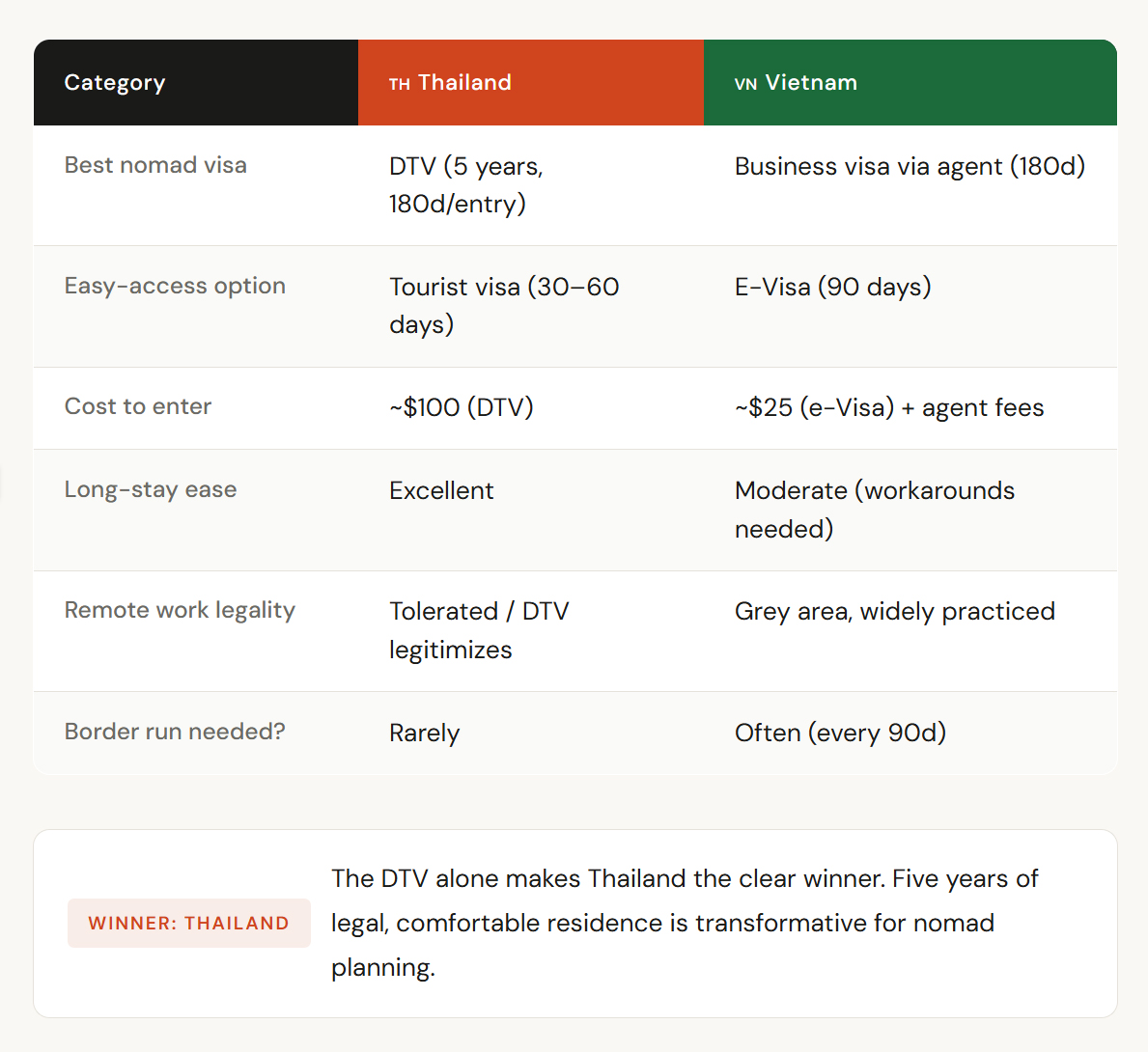
Visa strategy is where Thailand and Vietnam diverge most sharply — and where Thailand’s advantage is most concrete.
Thailand
Thailand introduced the Destination Thailand Visa (DTV) in 2024, and it has become the gold standard for digital nomads in Southeast Asia. A single-entry fee of roughly $100 grants a 5-year validity with 180-day stays per entry — provided you demonstrate $15,000 in accessible funds. Pair this with the standard 30-day tourist visa-on-arrival (extendable to 60 days), and Thailand is extremely accommodating. The Education (ED) Visa, typically obtained through a Thai language or Muay Thai school, offers another long-stay route at lower cost.
Vietnam
Vietnam’s 90-day e-Visa is easy to obtain online, but 90 days passes fast. Extending it has historically been unreliable. A Business Visa (DL) gives up to 180 days and is the preferred route for longer stays — though it usually requires sponsorship through a Vietnamese company or an agent (fees typically $150–$300). Many nomads simply do a visa run to a neighboring country every 90 days, which adds cost and friction. Vietnam has long promised a formal digital nomad visa, but as of 2026, meaningful long-stay options still require workarounds.
Cost of Living Reality Check
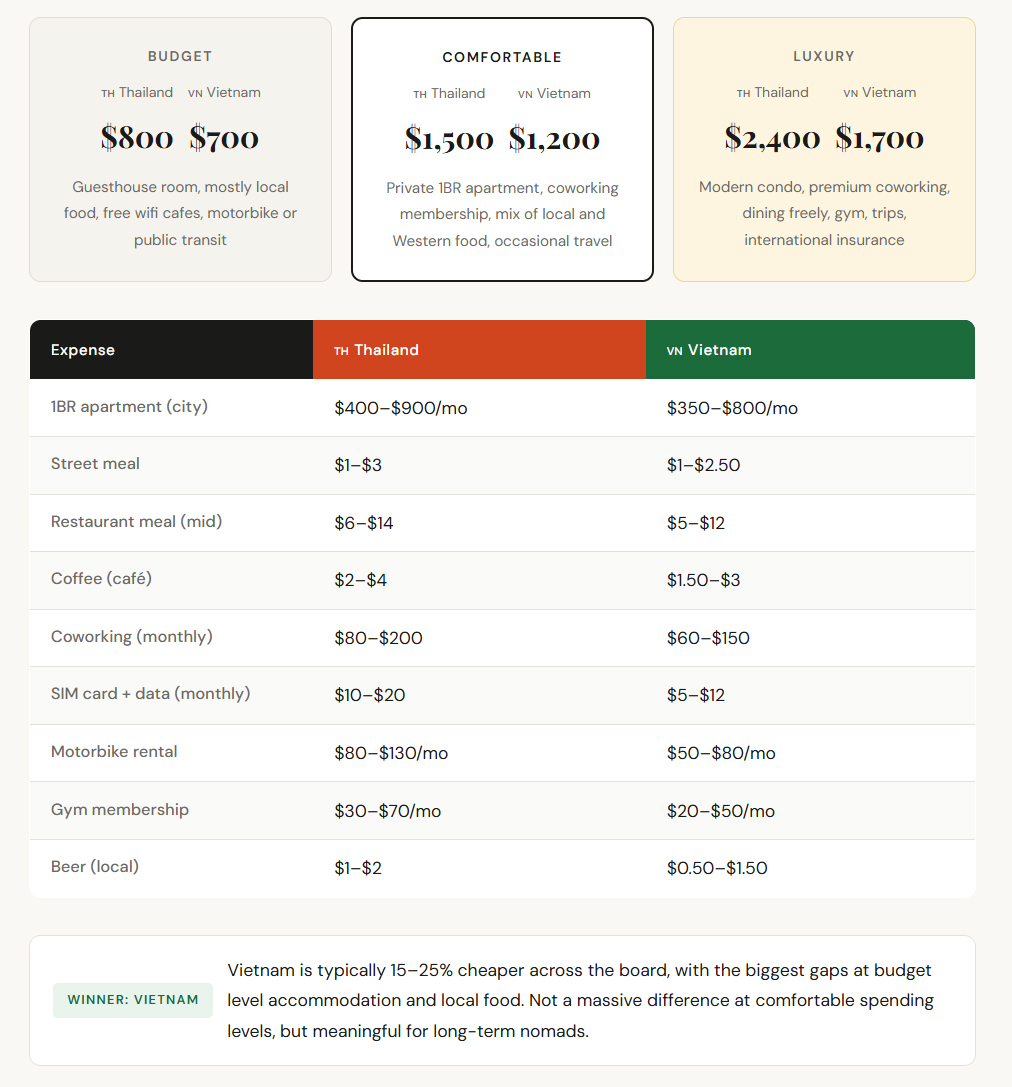
Both countries are dramatically cheaper than North America or Western Europe, but the gap between them is real — particularly at the budget end. Vietnam edges out Thailand on accommodation and local food; Thailand counters with more affordable Western imports and consistent restaurant quality.
Monthly budget scenarios (solo nomad)
Major Cities Head-to-Head
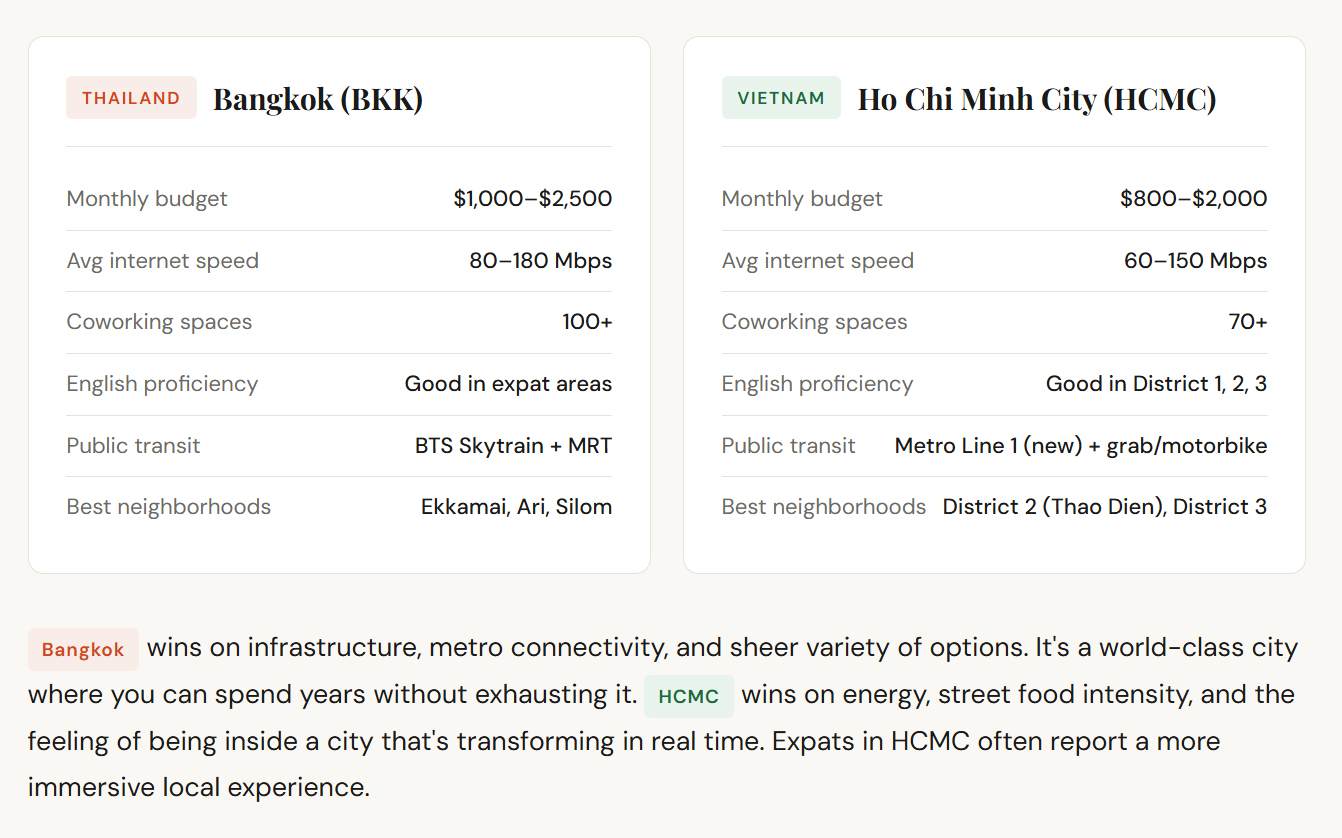
Bangkok vs. Ho Chi Minh City
These are the two dominant metropolises of Southeast Asia, each the economic and cultural engine of their country. Bangkok is larger, more developed, and has a longer history of serving expats. Ho Chi Minh City is frenetic, rapidly modernizing, and has a particular energy that long-term nomads either adore or find exhausting.
The doors are open on Nomados Pro!
Plan journeys. Save itineraries. Use Miles, your AI travel assistant, to think through options and decisions. Add services on demand like airport lounges, data plans, and visas when you need them.

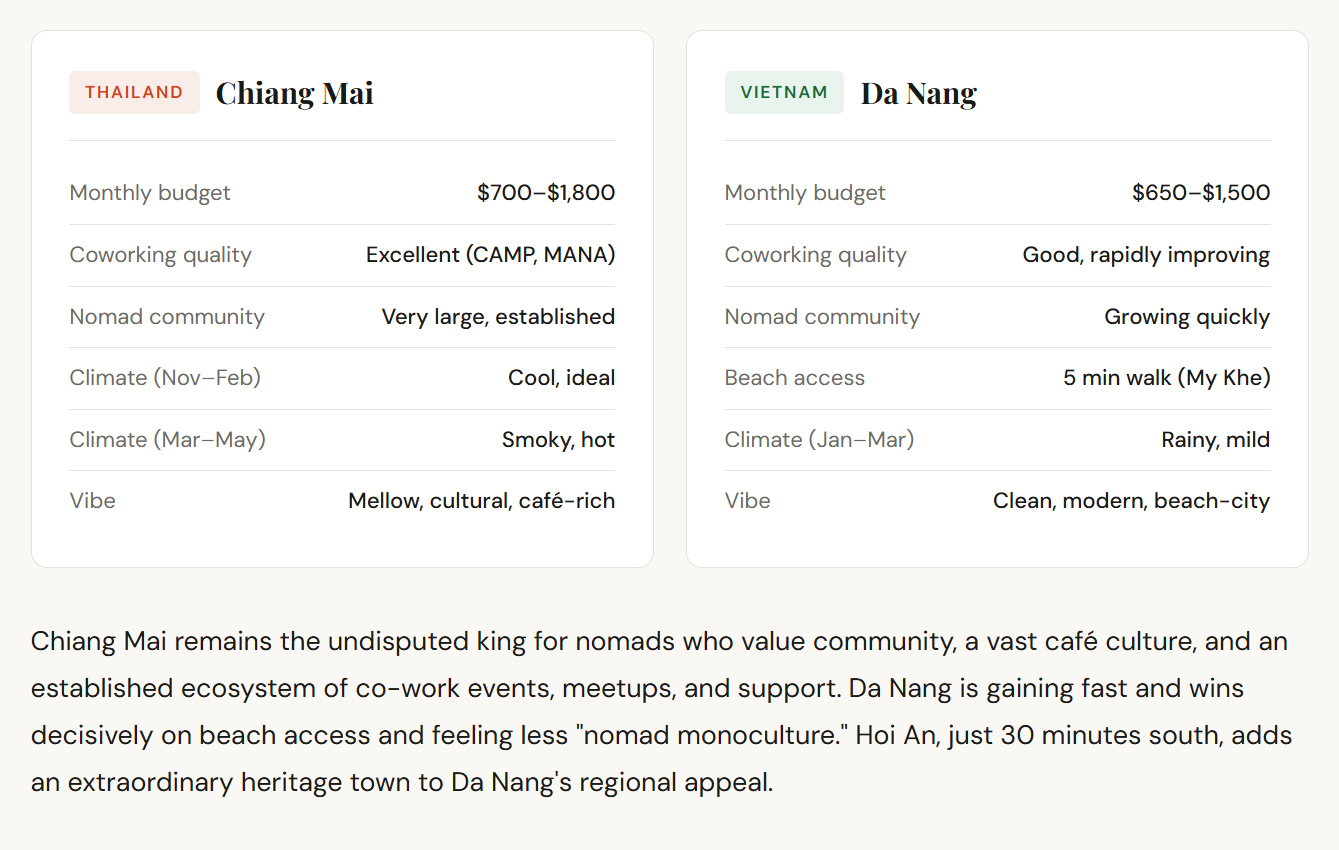
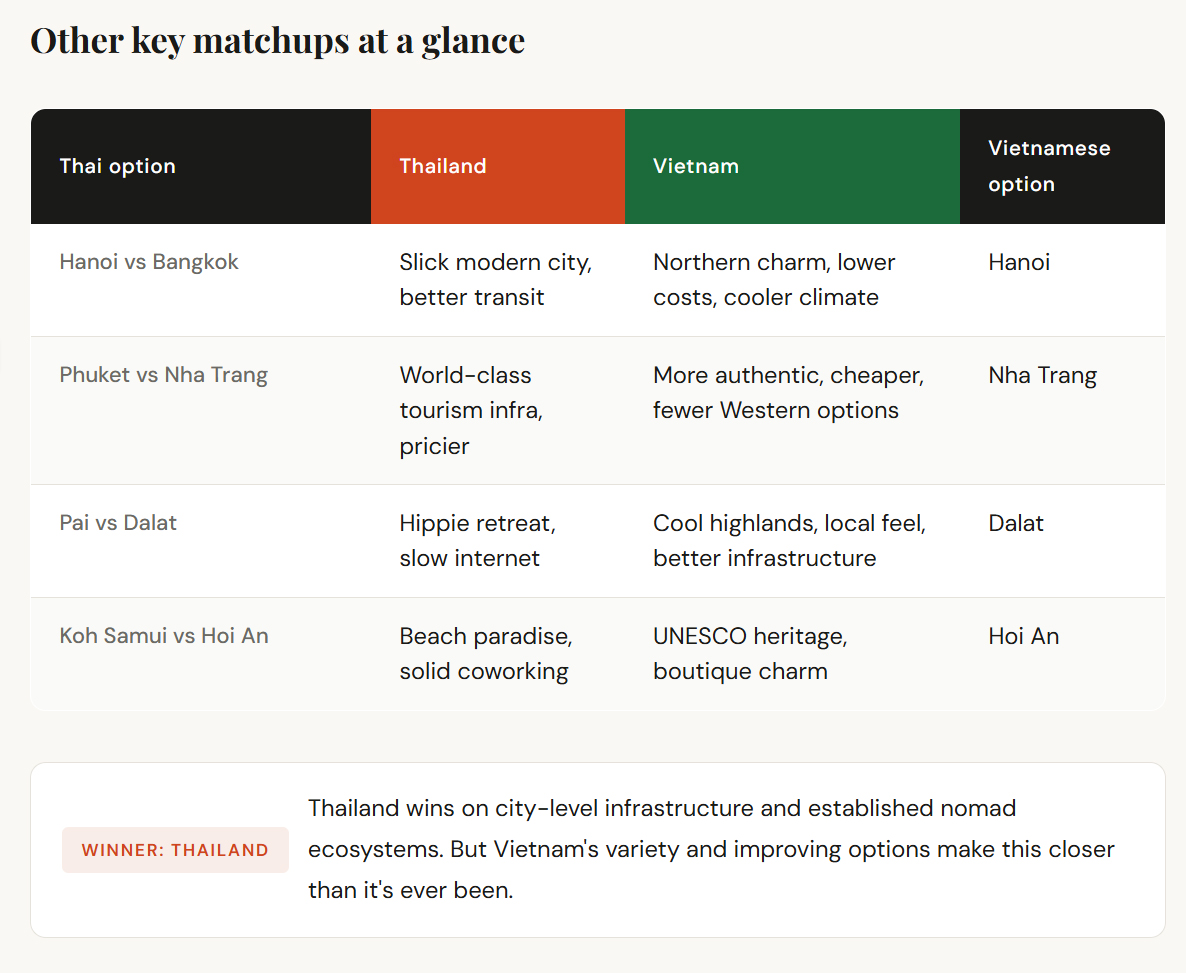
Chiang Mai vs. Da Nang
This matchup is particularly important because both cities are frequently cited as the best “second city” option for nomads in their respective countries. Chiang Mai has a decade-long reputation as a digital nomad capital. Da Nang is the challenger — a beach city with improving infrastructure that has exploded in popularity since 2022.
Internet & Infrastructure
For remote workers, internet is everything. Both countries have made major investments in connectivity over the last five years, though reliability varies dramatically between locations.
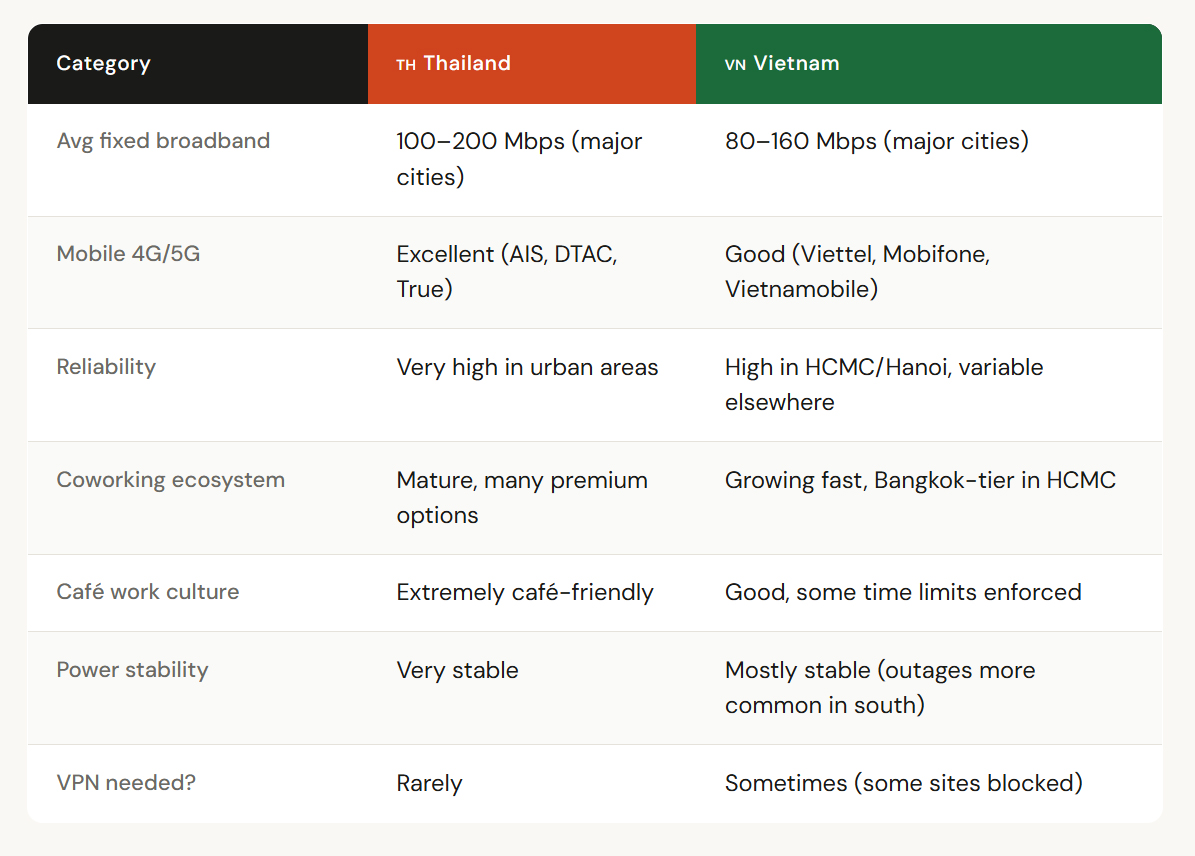
More consistent nationwide, with a more developed coworking infrastructure and fewer connectivity surprises in secondary destinations.
Cultural Experience Comparison
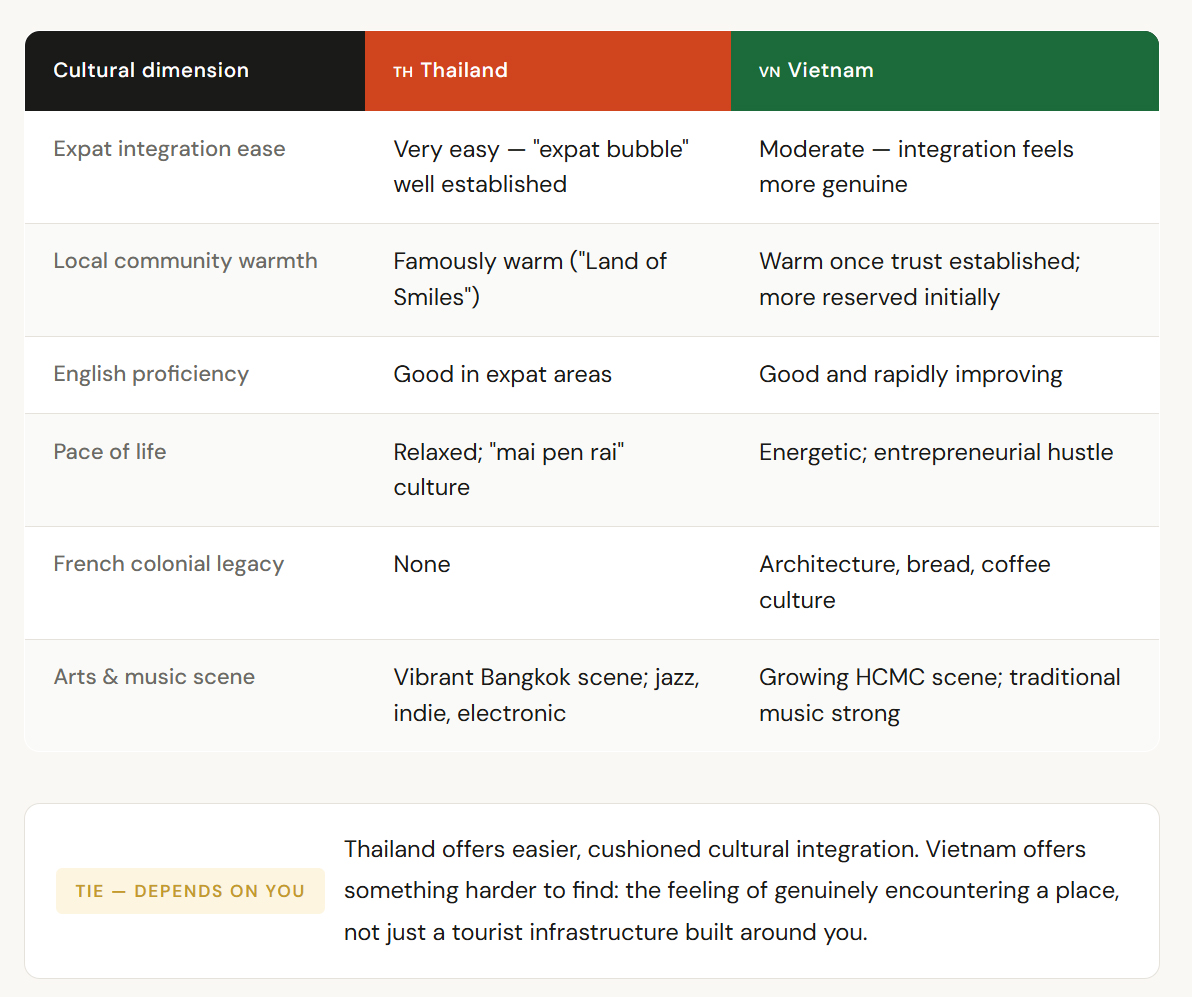
Culture is where “better” becomes deeply subjective. Thailand and Vietnam offer profoundly different cultural landscapes — both rewarding, but appealing to different types of traveler.
Buddhism and spirituality
Thai Theravada Buddhism permeates daily life in a visible, accessible way: monks in saffron robes collecting alms at dawn, ornate temple complexes on every other street, and a cultural emphasis on sanuk (fun) and jai yen (cool heart) that softens social friction and creates a genuinely welcoming atmosphere. Vietnam’s Buddhism carries Chinese Mahayana influences and coexists with Taoism, Confucianism, and ancestor veneration, resulting in a richer but more layered spiritual landscape. Both produce stunning festivals — Thailand’s Yi Peng lantern festival and Songkran water festival are bucket-list experiences; Vietnam’s Tết celebrations are among the most atmospheric in the world.
Language and integration
Thai is notoriously tonal (five tones) and uses its own alphabet, meaning you can live comfortably in Bangkok for years using only English. Vietnamese is also tonal (six tones in the northern dialect) but uses a Romanized script — you can read street signs and menus within days. English proficiency is broadly similar in tourist and expat zones, though Vietnamese younger generations are notably enthusiastic English learners. Outside major centers, both countries require patience and gesture.
Food Scenes Face-Off
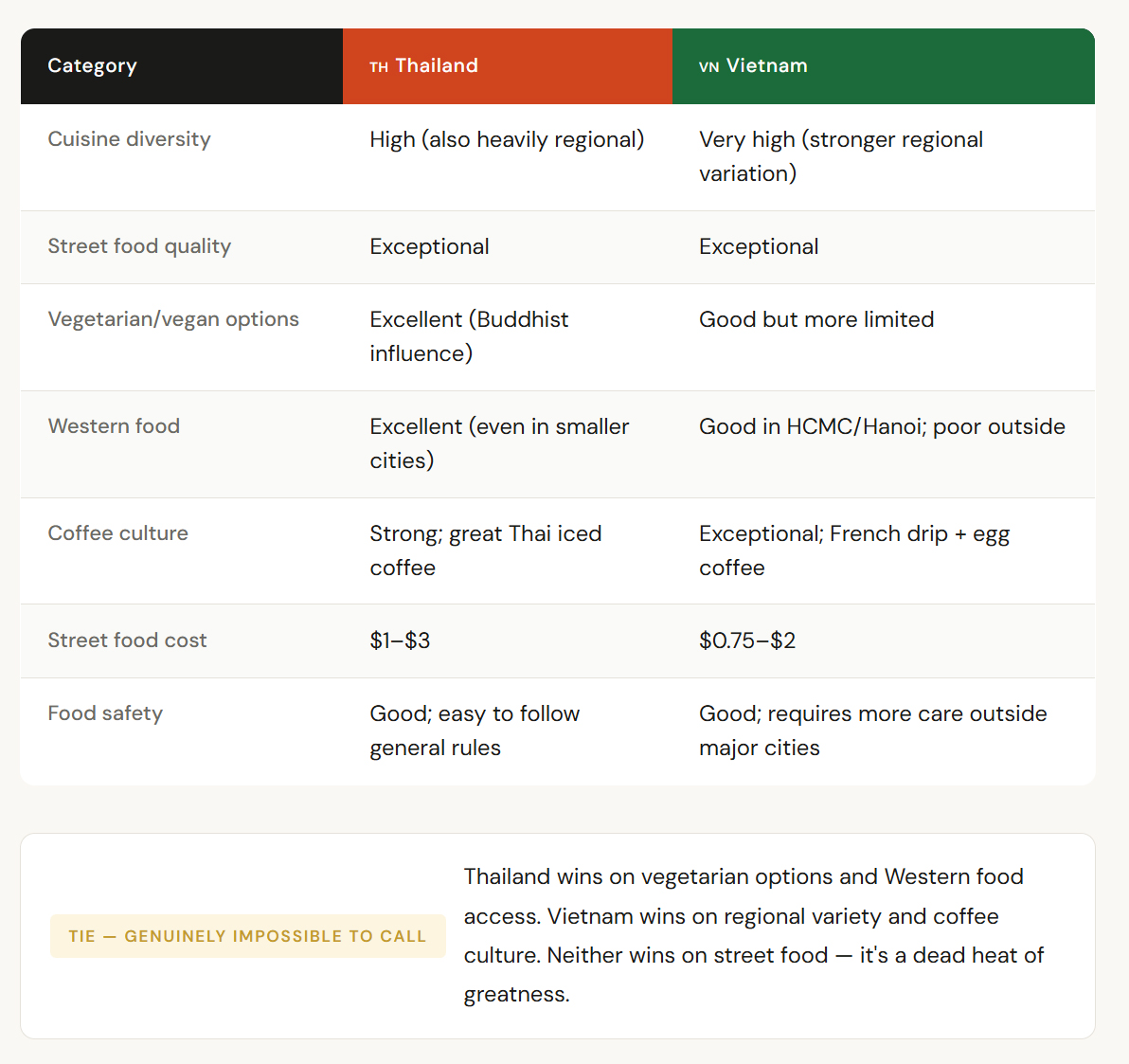
This is the section that sparks the most arguments in nomad forums. Both countries produce world-class cuisines. We’ll try to be fair.
Thailand
Thai cuisine is globally recognized and beloved for a reason: the balance of sweet, sour, salty, spicy, and umami is relentlessly sophisticated. Pad thai, green curry, som tum, khao pad, tom kha — every dish is deeply developed over generations. Bangkok has a legitimately world-class restaurant scene alongside extraordinary street food. The country is extremely vegetarian and vegan friendly, particularly around Buddhist communities. Western food availability is exceptional, and international grocery stores like Villa Market stock imported goods from around the world.
Vietnam
Vietnamese cuisine is arguably more regionally diverse — pho from Hanoi, banh mi and broken rice from HCMC, cao lau from Hội An, bún bò Huế from the center. The French colonial legacy introduced baguettes, pastries, and an extraordinary café culture (the drip coffee — cà phê phin — is a way of life). Street food stalls in HCMC are the densest and most exciting in the region. Vegetarian options exist but are more limited than Thailand. Western food in major cities is strong; outside them, options thin quickly.
Island & Beach Options
Both countries have stunning coastlines. Thailand’s island infrastructure is more developed and better suited to nomads who want to work from the beach. Vietnam’s coastal areas offer more authenticity but less infrastructure.
Thailand’s islands
Koh Phangan has evolved beyond the Full Moon Party into a genuine wellness and digital nomad hub — high-season internet is excellent, coworking spaces have multiplied, and the yoga and health scene is world-class. Koh Samui offers airport access and more upmarket options. Phuket is fully developed, expensive by Thai standards, but delivers the most reliable infrastructure. All three have strong connectivity, English-speaking staff, and established expat communities. The Andaman islands (Koh Lanta, Koh Yao Noi) offer quieter alternatives with improving infrastructure.
Vietnam’s coastline
Phú Quốc, off the southwest coast, has seen rapid development since gaining island province status and is now Vietnam’s most developed beach destination — with reliable internet and coworking options. Con Dao remains beautifully undeveloped, though this means connectivity is unreliable. The central coast from Da Nang to Mũi Né offers a near-continuous beach scene. Hạ Long Bay, while primarily a sightseeing destination, makes an excellent weekend escape from Hanoi.
Safety & Healthcare
Both countries are broadly safe for digital nomads, with caveats. The most common hazards in both are traffic (extremely dangerous in both), petty theft in tourist areas, and specific tourist-targeted scams.
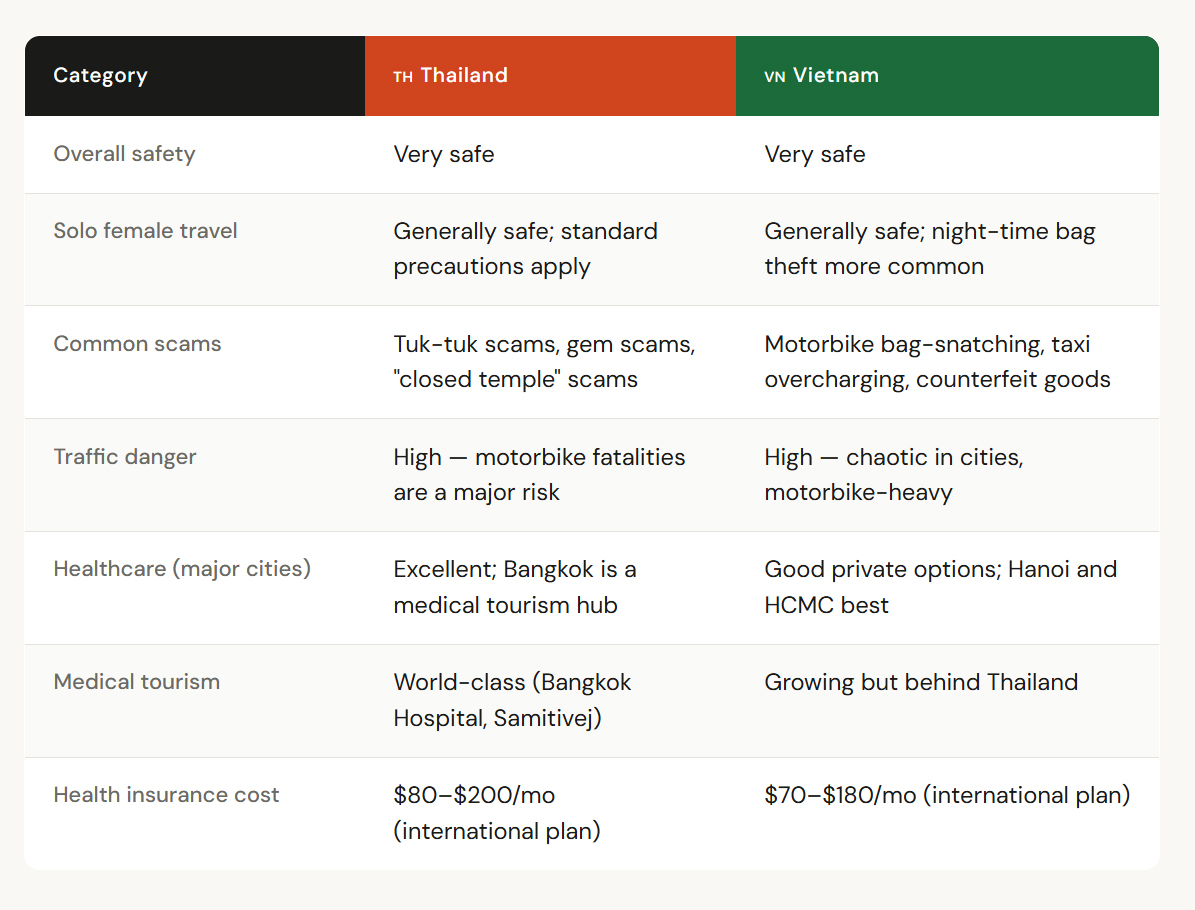
Thailand’s private hospitals in Bangkok are genuinely world-class — Bumrungrad, Samitivej, and Bangkok Hospital all offer international-standard care with English-speaking doctors and transparent pricing. Vietnam’s private hospitals in HCMC and Hanoi are solid for routine care, but for serious conditions, many expats prefer to fly to Bangkok. This is worth factoring into your choice if health is a consideration.
Winner: Thailand
Comparable day-to-day safety, but Thailand’s healthcare system — particularly Bangkok’s private hospitals — is significantly superior.
Practical Considerations
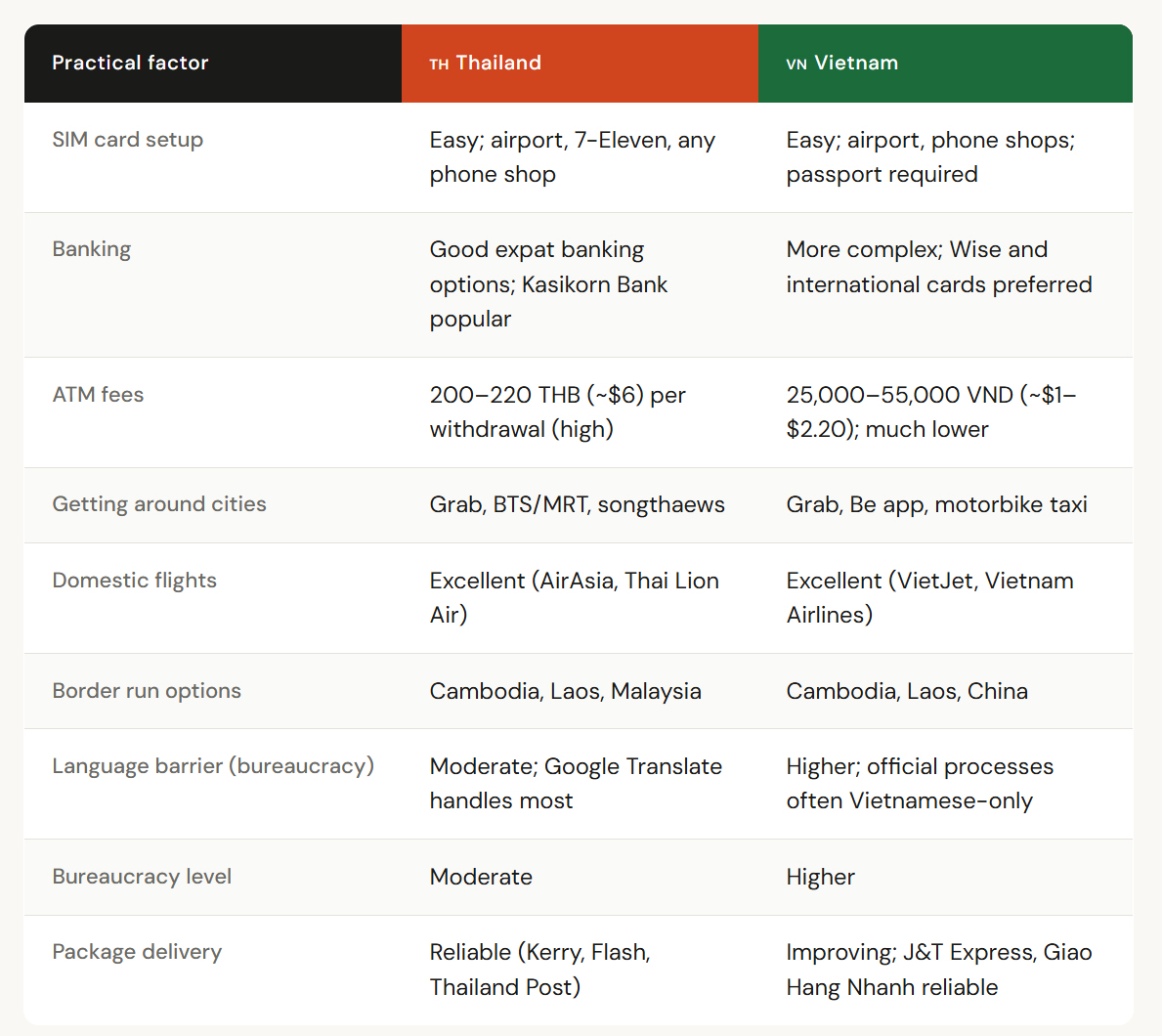
One underappreciated practical edge for Vietnam: ATM fees are dramatically lower. Thailand’s Kasikorn Bank charges 220 THB per international withdrawal — this adds up fast. Vietnam’s fees are a fraction of that. Conversely, Thai banking is far easier to navigate as a foreigner if you need an actual local account.
Winner: Thailand
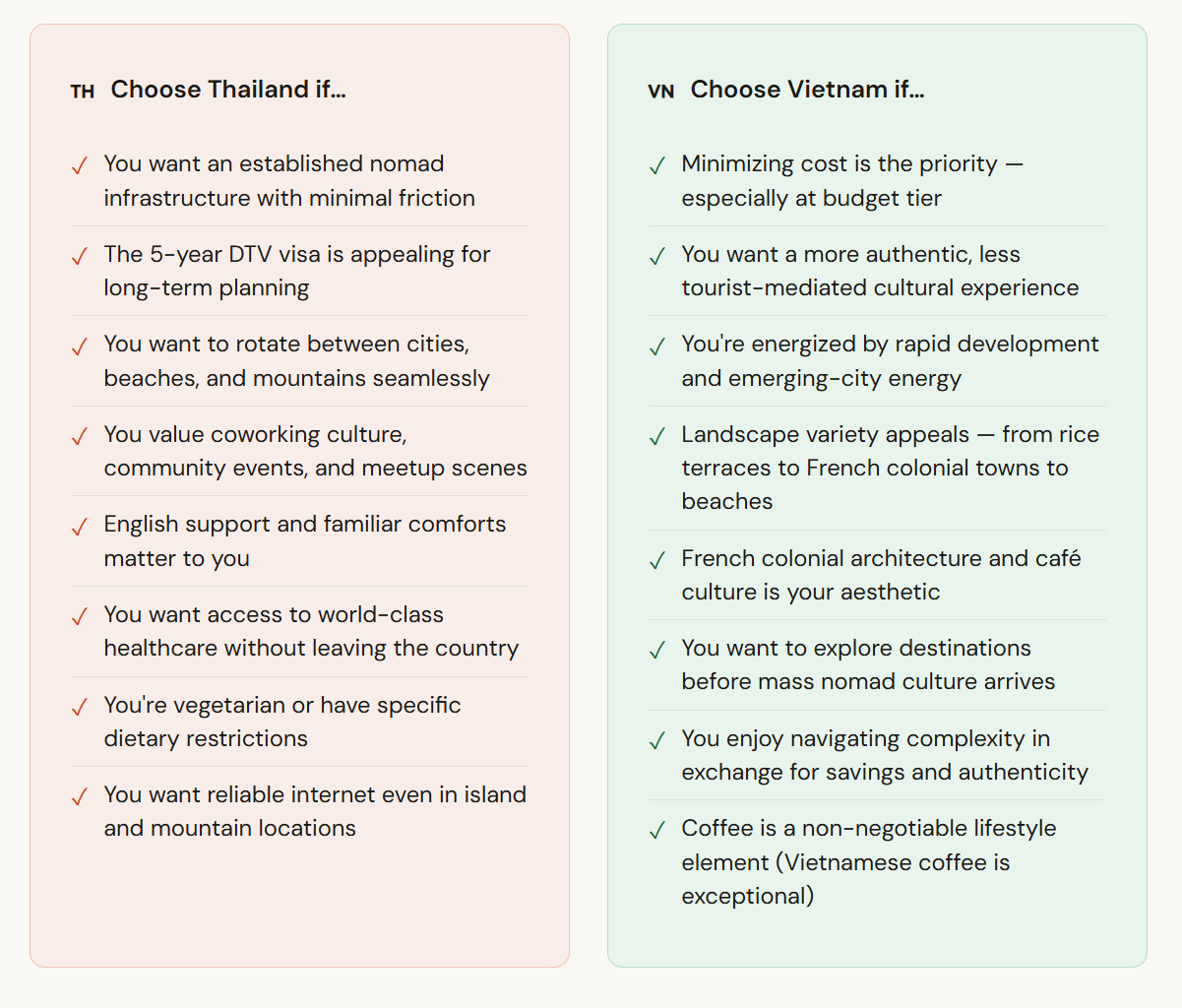
Which Country Should You Choose?
The Hybrid Approach — What Most Experienced Nomads Actually Do
The false premise of this comparison is that you must choose one. The vast majority of long-term Southeast Asia nomads rotate between both countries. A common pattern: spend the dry-season peak (November–February) in Thailand — Chiang Mai cool season, Bangkok, or islands — then shift to Vietnam for spring. Flights between Bangkok and HCMC or Hanoi run frequently and cheaply, often under $50. Many nomads use Thailand as their permanent base (thanks to the DTV) and treat Vietnam as an extended trip. Others prefer to base in Da Nang or HCMC and treat Bangkok as a quarterly medical/shopping/networking visit. The logistics are genuinely easy.
Frequently Asked Questions
1. Which is cheaper, Thailand or Vietnam?
Vietnam is typically 15–25% cheaper, most noticeably in accommodation and local food. At a budget level, a comfortable solo nomad lifestyle in Vietnam runs roughly $700–$1,200 per month compared to $800–$1,500 in Thailand. At comfortable-to-luxury spending levels the gap narrows. Thailand’s ATM withdrawal fees and higher Western food costs widen the difference at higher spending levels.
2. Which has better visa options for digital nomads?
Thailand is the clear winner. The Destination Thailand Visa (DTV) provides 5-year validity with 180-day stays per entry, requiring $15,000 in accessible funds and costing around $100. Vietnam still lacks a formal digital nomad visa in 2026. Most nomads use Vietnam’s 90-day e-Visa and do quarterly border runs, or arrange a 180-day business visa through an agent — adding cost and friction compared to Thailand’s official long-stay route.
3. Is Thailand or Vietnam safer for digital nomads?
Both countries are broadly very safe by global standards. The biggest risks in both are traffic, petty theft in tourist areas, and tourist-targeted scams. Thailand’s healthcare infrastructure is significantly superior — Bangkok’s private hospitals are world-class — which is a meaningful safety consideration for longer stays. Vietnam sees slightly more bag-snatching incidents, particularly for solo female travelers after dark in busy urban areas.
4. Which has better internet for remote work?
Thailand, particularly outside major cities. Both countries have excellent connectivity in Ho Chi Minh City, Hanoi, Bangkok, and Chiang Mai. Thailand maintains better speeds and reliability in secondary cities, tourist islands, and mountain towns. Vietnam’s connectivity can be inconsistent in smaller destinations like Hội An, Đà Lạt, or Phú Quốc outside developed resort areas. A VPN is also more useful in Vietnam due to occasional content filtering.
5. Which has better food — Thailand or Vietnam?
This is genuinely too close to call. Thailand wins on vegetarian and vegan options, Western food availability in secondary cities, and consistency. Vietnam wins on regional cuisine diversity, coffee culture, and the French colonial influence on baked goods and café culture. Street food quality in both countries is exceptional. Most nomads who have spent serious time in both refuse to answer this question definitively.
6. Can I easily travel between Thailand and Vietnam?
Yes, very easily. Flights between Bangkok and Ho Chi Minh City or Hanoi are frequent, often under $50, and take 1.5–2.5 hours. Budget carriers including AirAsia, VietJet, and Thai Lion Air serve multiple daily routes. Many nomads treat the two countries as a single extended destination, rotating seasonally or when one country’s visa requires a reset.
Conclusion
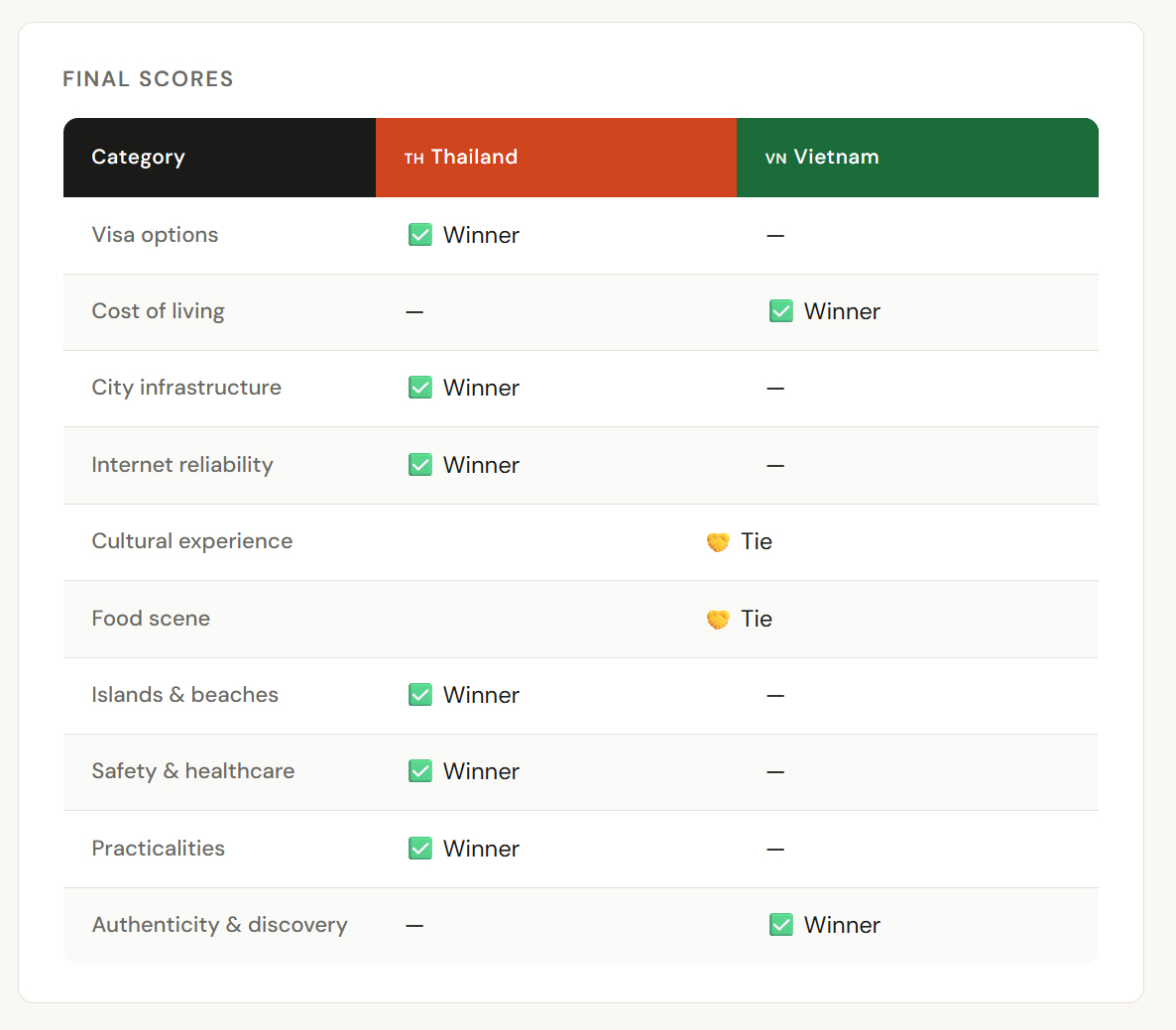
After examining visas, costs, cities, infrastructure, culture, food, beaches, safety, and practicalities, the scorecard reads something like this: Thailand wins on infrastructure, visa clarity, healthcare, and island work-life. Vietnam wins on cost, authenticity, coffee, and the particular thrill of being somewhere that’s still figuring out what it’s becoming.
Thailand is the safer bet — in the broadest sense of that phrase. The nomad ecosystem is deep, the visa situation is genuinely solved with the DTV, and you can land in Bangkok with no local knowledge and be comfortably set up within a week. For first-time Southeast Asia nomads, or those who value certainty, it’s the stronger starting point.
Vietnam rewards those who lean in. The complexity pays off in an experience that feels less like living inside a nomad product and more like actually inhabiting a country. If you’ve already done Thailand, or you’re specifically budget-constrained, Vietnam is the natural next move.
And for the majority of nomads who’ll spend meaningful time in both: the real answer is that Southeast Asia, taken as a whole, is the most compelling region in the world for location-independent work. Thailand and Vietnam are its two crown jewels. You don’t have to choose — you just have to decide where to land first.
Costs and visa details are accurate as of April 2026. Both countries’ policies and exchange rates are subject to change — always verify current requirements through official government sources before you travel.
Disclosure: Portions of this article were created with the assistance of AI tools and reviewed by the Nomados editorial team for accuracy and clarity.