
Lounge access got complicated when it became a perk. A reward. Something to earn through spending or status or loyalty.
Seven options exist that don’t require a credit card. Some are genuinely good. Some look better than they are.
Here’s every option, ranked from least to most valuable — based on total cost, flexibility, what you have to give up, and what you actually get in return.
1. Flying Business or First Class
How it works: Premium cabin passengers on most major airlines receive complimentary lounge access as part of their ticket. No membership required, no credit card needed. The boarding pass gets you in.
What it actually costs: The lounge is free in the sense that it’s included. But the ticket isn’t. On a typical transatlantic route, the difference between economy and business class runs anywhere from $2,000 to $5,000 or more.
Do the math on lounge access alone and you’re looking at hundreds of dollars per visit — before you’ve touched a drink or found a seat.The in-flight experience is a different conversation.
A lie-flat seat and a proper meal have real value. But choosing business class for the lounge is a bit like buying a car for the parking spot.
Best situation for this option: Flying premium for other reasons and treating the lounge as a bonus.
The verdict: Highest cost per lounge visit of any option on this list. Zero flexibility. Don’t choose a cabin class for the lounge.
2. Airline Elite Status
How it works: Reach a certain tier in an airline’s frequent flyer program and lounge access typically comes with it. Delta Platinum Medallion, United Premier Gold, American Executive Platinum, and similar status levels at most major carriers include lounge access on qualifying flights. No extra fee once you have it.
What it actually costs: Status looks free until you account for what it takes to earn and keep it. Most programs require a minimum number of miles, segments, or dollars spent with a single airline every calendar year. Miss the threshold and status drops. Take your business elsewhere for a year and you’re starting over.
There’s also an opportunity cost that rarely gets discussed. Staying loyal to one airline to protect status often means paying more for flights, accepting inconvenient routings, or flying at worse times than a traveler without loyalty constraints would ever choose. That delta adds up.
And the access itself is conditional in a way that matters. Status is worthless on a flight operated by a carrier outside your loyalty program. It disappears the year you don’t fly enough. It only works at airports where your airline has a lounge.
Best situation for this option: Already have status and fly the same airline consistently enough to keep it without chasing it.
The verdict: Great when you have it. A poor strategy to pursue purely for lounge access. The strings here are real and long.
3. Walk-Up Day Passes
How it works: Many airport lounges sell single-entry day passes at the door or online in advance. No membership, no annual commitment. Pay for the visit, go in.
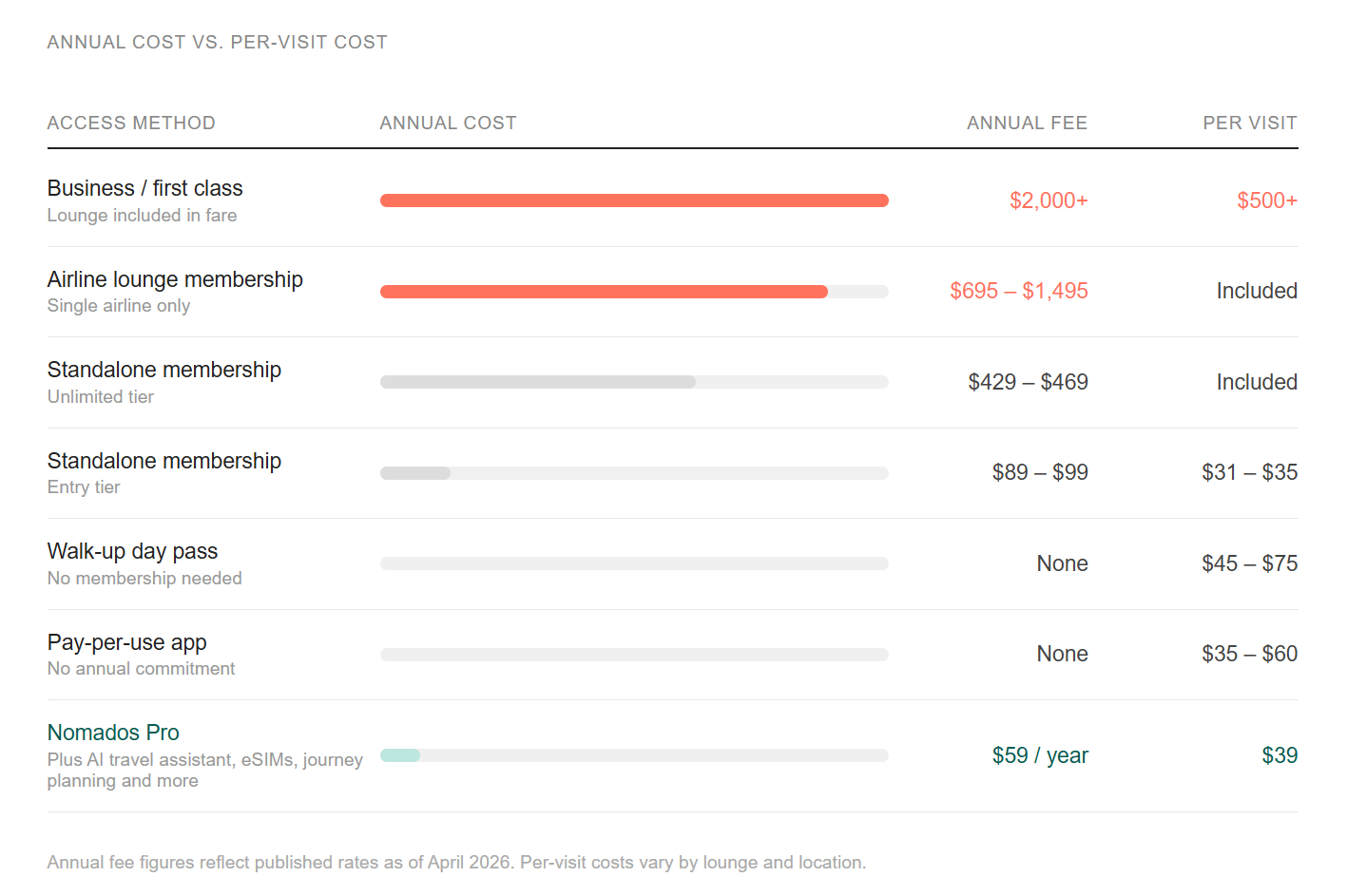
Prices typically run $45 to $75 per person depending on the lounge and airport. American, Alaska, and United sell day passes to their lounges directly. Delta discontinued walk-up access to Sky Club entirely. Independent lounges vary.
What it actually costs: The per-visit cost is the whole cost, which makes it simple but expensive for anyone using lounges more than occasionally. At $50 a visit, five trips a year is $250 with nothing carried forward and nothing else included.
Availability is also not guaranteed. Walk-up access is subject to capacity, and at busy airports during peak travel periods the answer at the door is sometimes no, even with a pass booked in advance.
Best situation for this option: Genuine one-off situations. A long unexpected delay. An airport you’ll never fly through again.
The verdict: Simple and accessible. Expensive per visit. No ongoing value whatsoever.
4. Airline Lounge Memberships
How it works: Delta Sky Club, United Club, American Admirals Club, and other airline lounges offer annual memberships available for direct purchase.
No credit card required.
Prices range from around $695 to $1,495 per year depending on the airline and tier.
What it actually costs: A substantial annual commitment for access that only works with one airline’s lounges.
Delta Sky Club individual membership runs $695 per year.
United Club sits at $650 to $750 per year. That’s a significant number for something that’s completely useless the day a flight is operated by anyone else.
Hub dependency is also real. These memberships deliver their best value when flying frequently through an airline’s major hub cities. For anyone with a varied travel pattern across multiple carriers and airports, a single-airline membership leaves a lot of gaps.
Best situation for this option: Genuinely loyal to one airline, flying primarily through that airline’s hubs, with enough trips per year that the annual fee works out on a per-visit basis.
The verdict: Solid value in a narrow set of circumstances. Outside those circumstances, the strings are too tight and the cost too high.
5. Standalone Lounge Membership Programs
How it works: Independent lounge membership programs let you buy access to a global network of lounges without a credit card and without being tied to a single airline. Most offer tiered annual memberships ranging from entry-level plans with a per-visit fee to premium plans with unlimited access.
Typical pricing across the major programs looks something like this: entry level runs around $89 to $99 per year with a per-visit fee on top, mid-tier runs $259 to $329 per year with a set number of free visits included, and unlimited access sits at $429 to $469 per year. Networks cover anywhere from 1,300 to 1,800 lounges globally depending on the program.
The airline-agnostic access is a genuine advantage over airline-specific memberships. These programs work regardless of which carrier you’re flying, which makes them meaningfully more flexible for anyone whose travel isn’t dominated by a single airline.
What it actually costs: Getting to unlimited access through these programs means paying $429 to $469 per year for lounge access alone, with nothing else included. At the entry level, the annual fee plus per-visit costs can add up quickly for anyone using lounges regularly.
There’s also a crowding consideration worth being honest about. These programs are among the most widely distributed lounge access products in the market. The lounges they cover are often the same ones feeling the most pressure from high volumes of card-linked memberships. Access is not always guaranteed during peak periods even with a valid membership.
Best situation for this option: Frequent travelers who move across multiple airlines and regions, want a single flexible membership, and use lounges often enough to justify the annual commitment.
The verdict: Genuinely useful and airline-agnostic. But the annual fee is real, the cost is for lounge access only, and the most widely used networks share the same lounges that are increasingly crowded.
6. Pay-Per-Use Lounge Apps
How it works: A newer category of lounge access that works like a booking platform. Find a lounge, pay for a visit, get a digital pass. No annual membership, no credit card required beyond the transaction, no commitment of any kind.
Platforms in this category typically cover 1,400 or more lounges worldwide. Pricing runs roughly $35 to $60 per visit depending on the airport and lounge, with most falling in the $40 to $50 range for major international airports.
What it actually costs: The per-visit cost is the entire cost, which keeps things simple but limits the value for anyone traveling regularly. At $45 per visit, five lounge visits a year costs $225 with no annual value accumulating and nothing else included.
These platforms do one thing: lounge access. There’s no broader ecosystem, no travel tools, no planning infrastructure. For someone who also needs mobile data for a new country, visa help, or travel insurance, that’s four separate apps and four separate subscriptions alongside the lounge booking.
Best situation for this option: Occasional travelers who want maximum flexibility, visit lounges infrequently enough that the per-visit cost stays manageable, and have no interest in a broader travel subscription.
The verdict: The right answer for genuinely occasional use. The math shifts against it once lounge visits become a regular part of travel, and there’s no value beyond the visit itself.
7. Nomados Pro
How it works: Nomados Pro is a travel subscription that includes access to 1,800-plus airport lounges worldwide at $39 per visit, with a membership fee of $9 per month or $59 per year.
The membership isn’t built around lounge access alone. It’s built around the full reality of traveling frequently.
Everything included in the subscription:
- Airport lounges on demand at 1,800-plus locations worldwide at $39 per visit
- eSIM data: 10 to 20 percent off via Airalo
- eVisa services: 10 to 20 percent off via SimpleVisa
- Travel insurance: SafetyWing coverage available
- AI travel assistant: unlimited conversations with Miles
- Journey planning: unlimited saved itineraries
What it actually costs: At $59 per year plus $39 per visit, the math is straightforward.
Two lounge visits already puts the cost below walk-up day pass rates at most airports.
Five visits and the per-visit cost is competitive with or better than pay-per-use platforms, with a full year of every other tool in the subscription included.
Compared to standalone unlimited membership programs at $429 to $469 per year for lounge access alone, Nomados Pro costs significantly less for anyone using lounges fewer than ten times a year. Above ten visits the unlimited programs start to close the gap on lounge cost alone, but they include nothing else.
What makes it different:
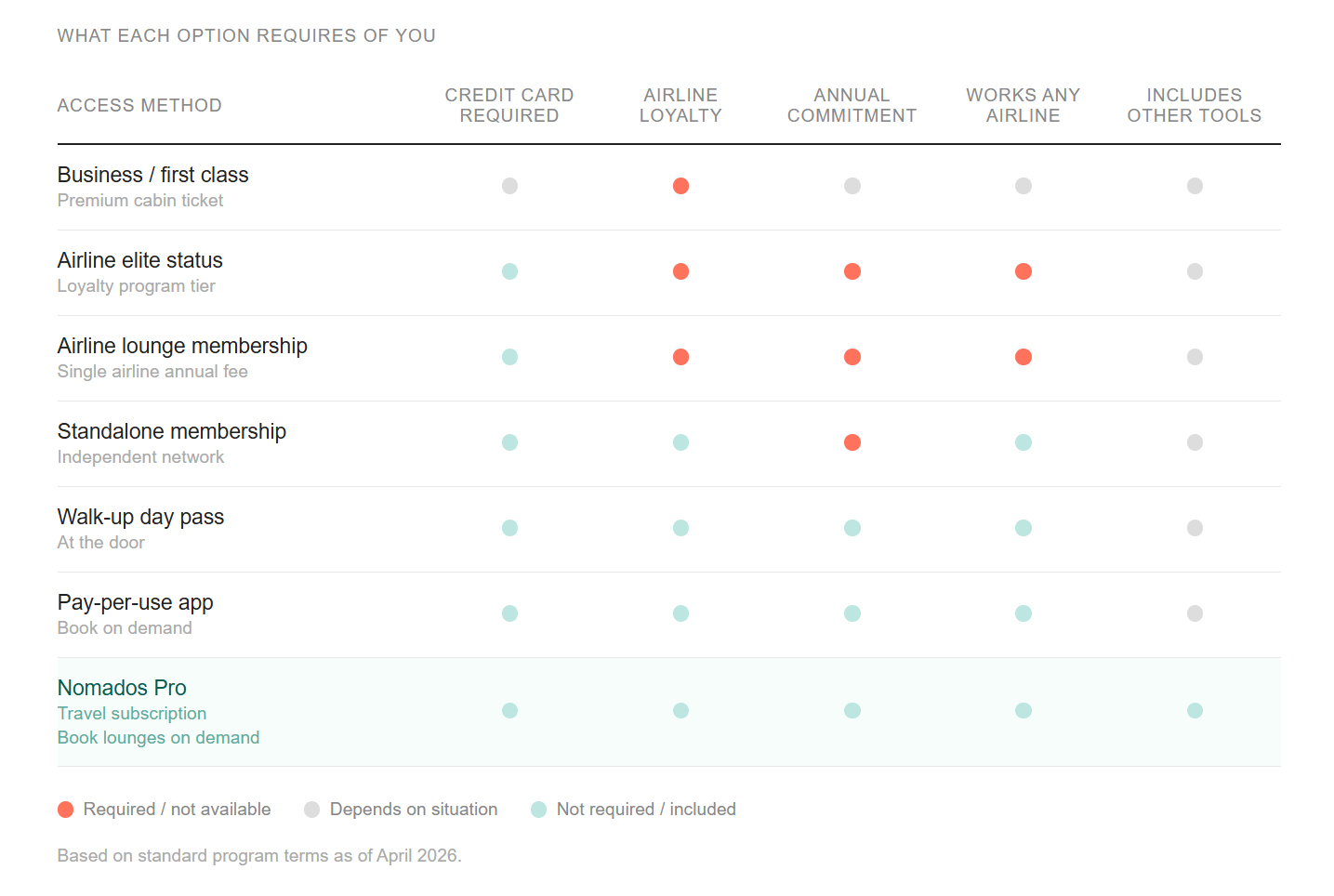
Every option above this one requires something beyond a subscription.
- A loyalty program to maintain.
- An airline to stay faithful to.
- A financial product to carry.
- A significant annual commitment to a single use case.
Nomados Pro requires none of that. It’s a subscription, the same model as any other tool built for people who live and work across borders. The lounge is the entry point.
Everything else is what makes it worth keeping.
Access is digital, through the Nomados app. No physical card, no registration at the desk, no program to manage separately from everything else.
Best situation for this option: Frequent travelers who want lounge access without a credit card, an airline, or a loyalty program involved, and who want more than just a lounge pass when they travel.
The verdict: Best overall value for anyone traveling regularly who wants flexibility, a fair per-visit price, and a subscription that handles more than just airport time. No credit card required. No strings.
The Bottom Line
The pattern across all seven options is consistent. The more lounge access is tied to a financial product, an airline, or a loyalty program, the more it costs in ways that aren’t always obvious. Annual fees, loyalty constraints, opportunity costs, and single-use limitations add up faster than the headline price suggests.
The options that ask the least of you in return tend to give the most. And the best one on this list isn’t the most well-known. It’s just the most honest about what travel actually looks like for people who do a lot of it.
Nomados Pro starts at $9 per month or $59 per year. Access 1,800-plus airport lounges worldwide, plus eSIM discounts, eVisa services, travel insurance, and an AI travel assistant — all in one place. See what’s included.
Frequently Asked Questions
Q: Can you access airport lounges without a credit card?
Yes. There are several ways to access airport lounges without a credit card, including purchasing walk-up day passes, joining standalone lounge membership programs, earning airline elite status, flying in a premium cabin, or subscribing to a travel platform like Nomados Pro that includes lounge access as part of a broader subscription.
Q: What is the cheapest way to get airport lounge access without a credit card?
It depends on how often you travel. For occasional travelers, pay-per-use platforms offer single-visit access without any annual commitment, typically ranging from $35 to $60 per visit. For frequent travelers, a subscription like Nomados Pro at $59 per year plus $39 per visit works out cheaper per visit than most walk-up rates and includes additional travel tools at no extra cost.
Q: Is airport lounge access worth it without a premium credit card?
For frequent travelers, yes. The comfort, reliable Wi-Fi, food, and quieter environment add real value to travel days. The key is choosing an access method that matches how often you actually travel. A pay-per-use option makes sense for occasional use. A subscription-based model like Nomados Pro makes more sense for anyone visiting lounges regularly, as the per-visit cost is lower and the subscription includes additional tools beyond lounge access.
Q: What is the difference between a lounge day pass and a lounge membership?
A day pass is a single-entry purchase with no ongoing commitment, typically costing $35 to $75 per visit depending on the lounge and airport. A lounge membership is an annual subscription that provides access to a network of lounges globally, either at a reduced per-visit rate or with unlimited access included. Memberships offer better value for frequent travelers but require an upfront annual fee regardless of how often the lounge is used.
Q: Do all lounge access programs require a credit card?
No. While many travelers access lounges through credit card benefits, several programs and platforms provide lounge access without one. Standalone membership programs can be purchased directly. Walk-up day passes can be bought with any payment method. And subscription platforms like Nomados Pro provide access to 1,800-plus lounges worldwide through a simple monthly or annual subscription with no credit card or financial product required.
Disclosure: Portions of this article were created with the assistance of AI tools and reviewed by the Nomados editorial team for accuracy and clarity.